 Dialect
Healthy relationships include dialogue.
Dialect helps you grow in conversation with God.
Speak your prayers aloud, and the words you sense in reply. Record your dreams. Dialect keeps them in your own voice, sets Scripture beside them, and over months helps you recognize the language He has been using with you all along.
A Christian prayer journal · in closed beta · invitation only for now
Because he has turned his ear to me, therefore I will call on him as long as I live.Psalms 116:2 · World English Bible
The journal
Prayer doesn’t come in one shape.
Some days you ask. Some days you only listen. Some mornings you wake with a dream still fresh, and it is gone by breakfast unless you say it out loud.
So Dialect doesn’t decide for you. You choose what you’re bringing, and it holds each kind differently — because they are different.
-
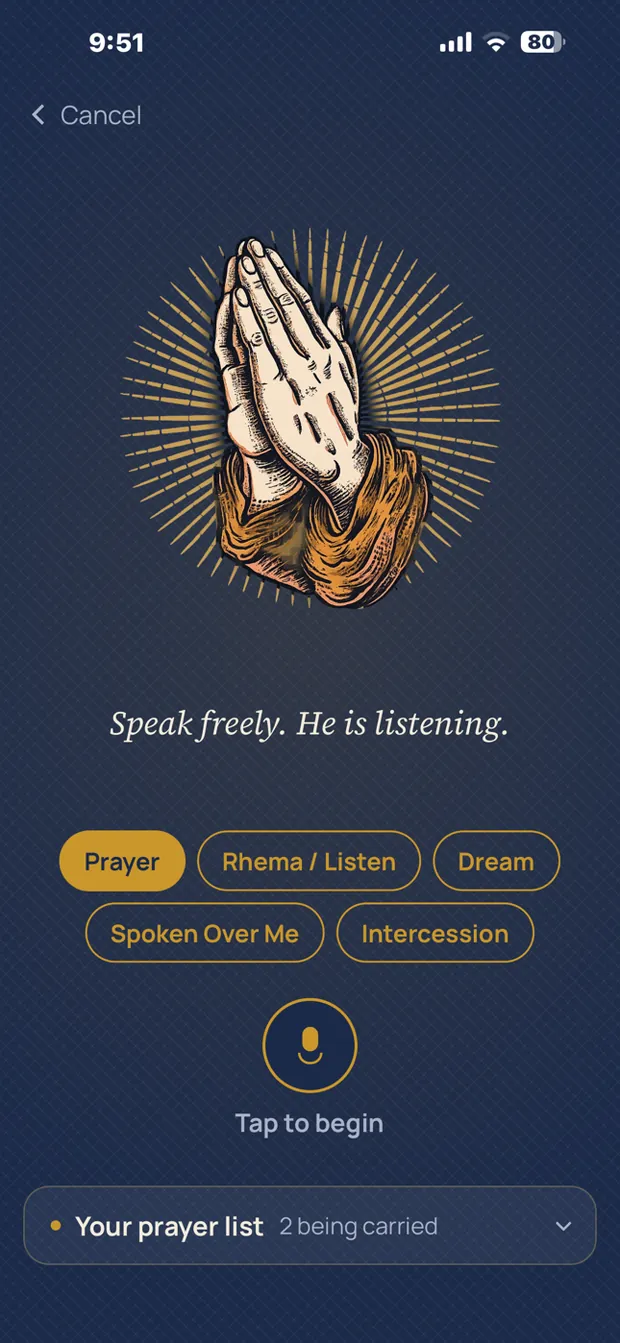
Prayer
Speak freely. He is listening.What you’re asking, carrying, or grateful for.
-
Listening
What you sensed Him say, in your own words, kept beside the prayer it answered — or standing on its own, because some days there was no question first.
-
A dream
He speaks in the night.Preserved while you still have it fresh in your mind.
-
Spoken over me
A word someone prays over you, caught in the room while it’s still being spoken.
-
Intercession
Stand in the gap for a friend.A prayer you record for someone else, and can send to them.
-
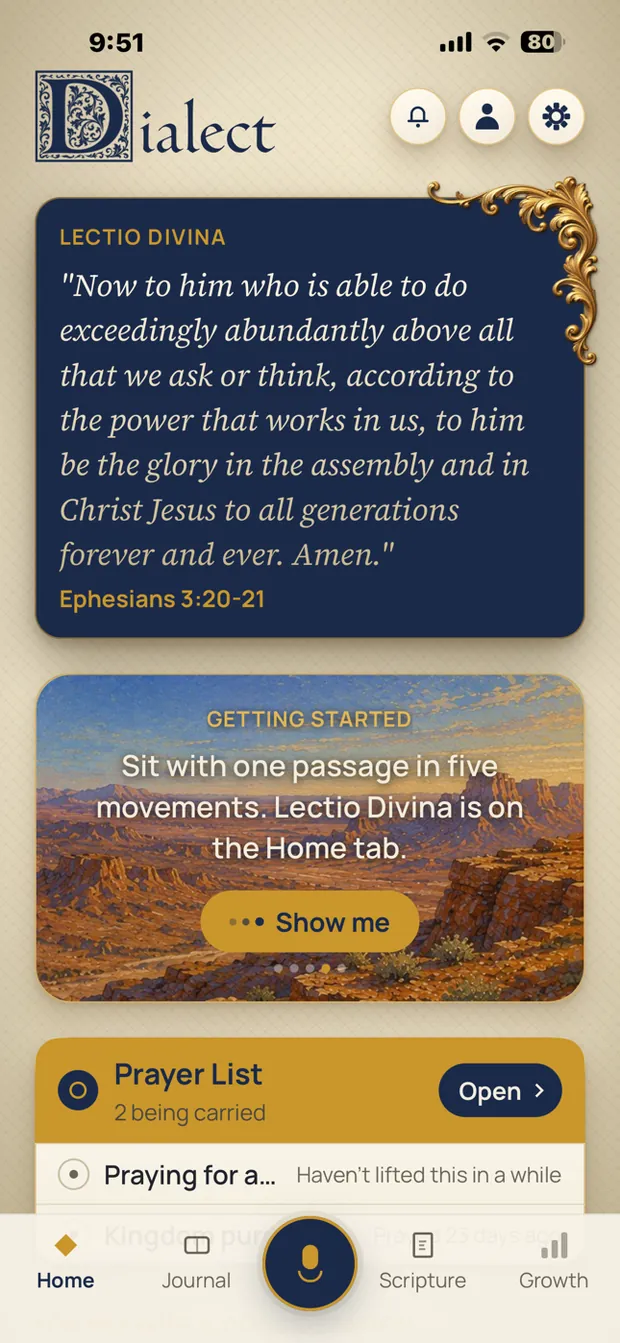
Lectio Divina
One passage, five movements, unhurried — kept as a single sitting.
You speak; it writes. Your words stay yours: nothing is tidied, shortened, or rephrased, and where a word was clearly misheard the app asks before it changes anything.
Scripture
You pray. The Word answers.
Beneath everything you record, Dialect sets Scripture that meets it — the passage for this morning, not a verse for mornings in general. And now and then one that challenges it: not a correction and never a verdict, but a passage, cited, with a question attached. Here is something Scripture also holds. What do you make of it?
That second kind is rare, and meant to be. Grief, lament, honest complaint, the long wait — these are not problems to be solved. The Psalms are full of them.
Every passage is a real reference, opened where it sits, so you can read what comes before and after and weigh it yourself. Nothing is paraphrased or summarized. If it cannot point to chapter and verse, it doesn’t speak.
Keep what lands. Set the rest aside.
Together
Discernment was never meant to be done alone.
A dream that doesn’t quite make sense. Something you heard the Lord say and want to weigh with others. A prayer you’d like someone to carry with you. Hand any of them to a friend, or to a small circle you’ve gathered — and they answer with a word, or with a prayer.
A prayer you record for someone can be sent to them, so it arrives in your voice and your words, the way you actually prayed it. A dream can be shared for counsel, or given outright — and if they keep it in their own journal, your name stays on it.
Nothing here is public. There is no feed, no discovery, no stranger reading over your shoulder. Every connection began with an invitation someone accepted, and every share is one thing, given to people you chose.
The Scripture tab
Somewhere to go when you don’t know where to begin.
Four ways in, and none of them is a search box you have to already know the answer to.
-
Explore by what you’re facing
Sixteen doors in. Anxiety and fear. Grief. Waiting. Doubt. Forgiveness. Guidance. Rest, when you are past tired. Each opens onto passages gathered for that, not a keyword search that hands you every verse with the word rest in it.
-
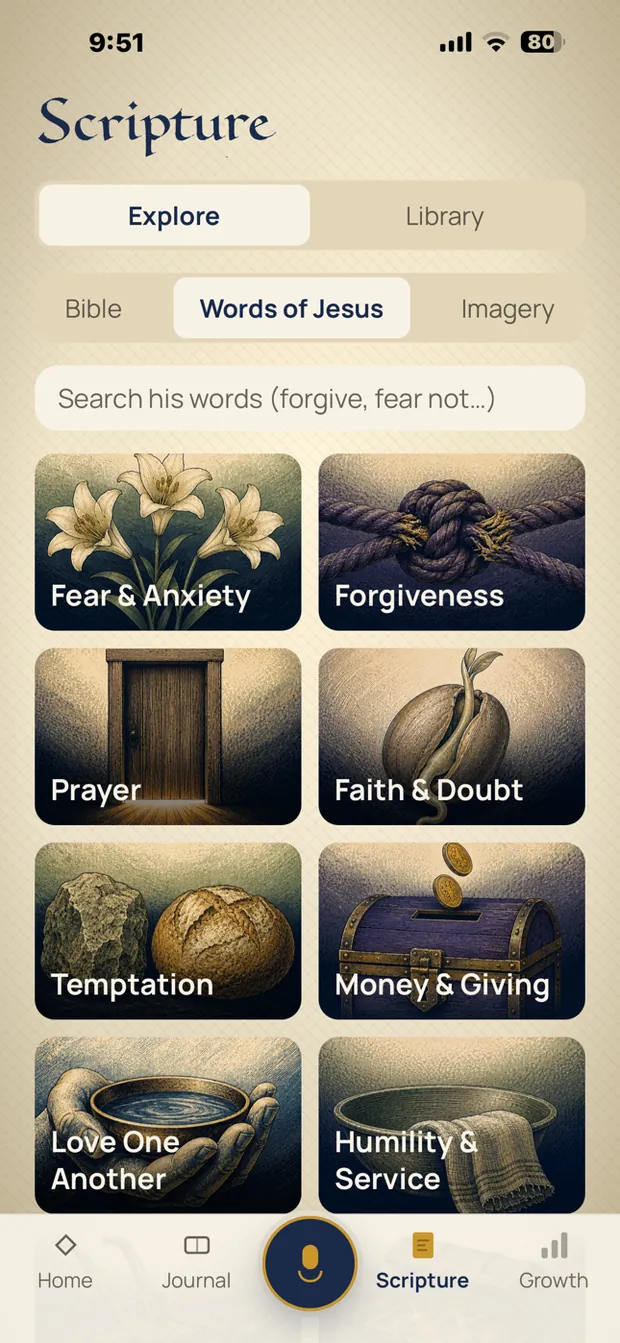
The words of Jesus
Every command He gave, all 331 of them, each read inside the passage it belongs to rather than clipped to a single line. Rejoice and be glad is the end of the Beatitudes; you read it there, where it means what it means. Where a saying appears in more than one Gospel, you see both — and you can take any of them straight into a Lectio sitting.
-
Biblical imagery
816 images Scripture uses, each shown across its whole range rather than reduced to one meaning. Water is chaos, and flood, and rest, and the living water within. The point is to widen what you see, not to hand you a key.
-
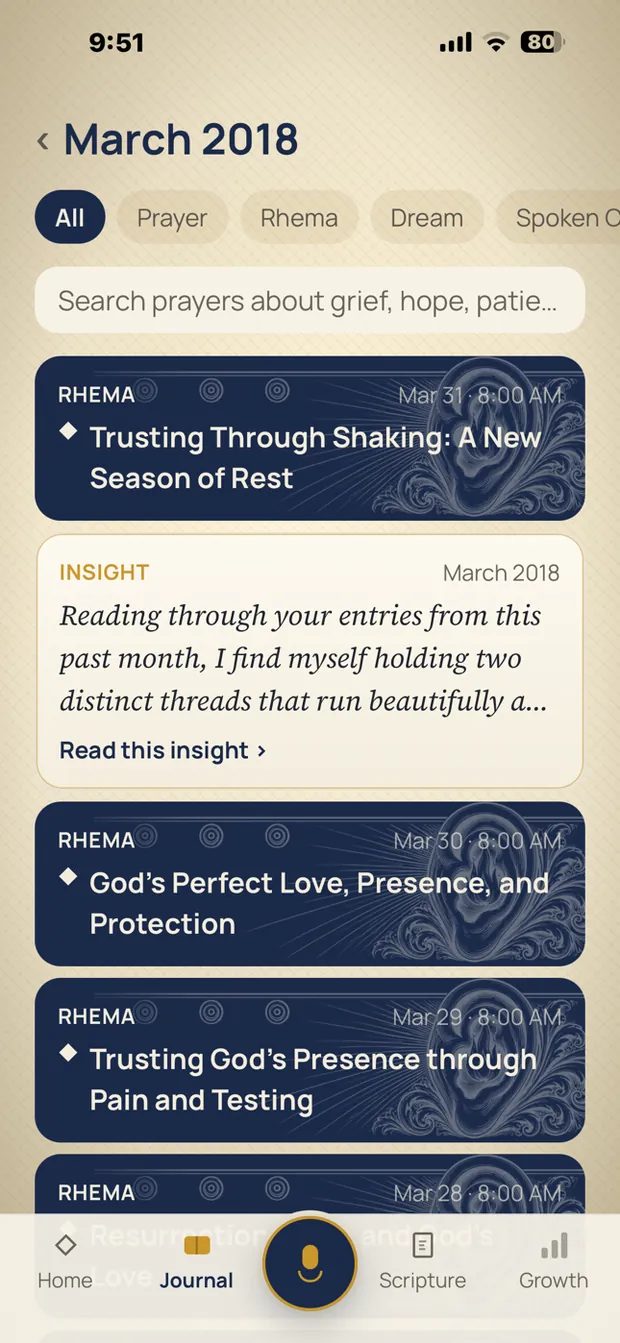
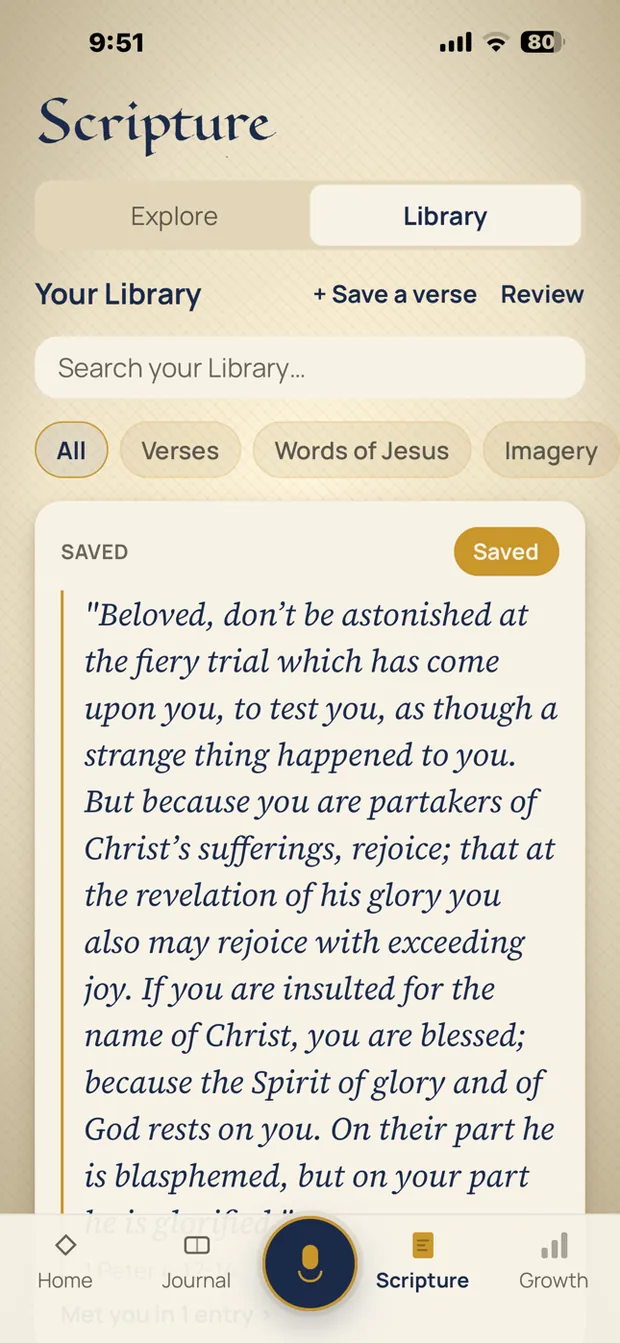
Your library
Every verse you’ve kept, from anywhere in the app, gathered in one place. The ones you went looking for, and the ones that kept finding you.
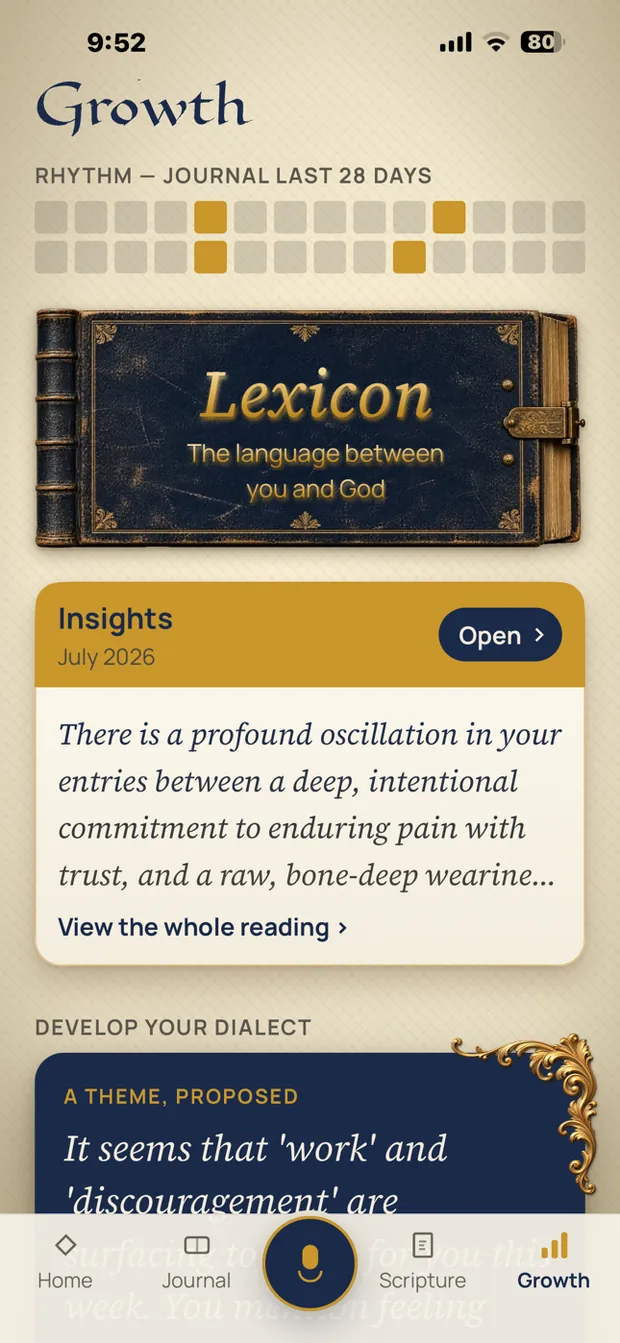
Your Lexicon
The language between you and God.
He has been using a vocabulary with you. A particular image that keeps arriving. A word that lands differently than it does for anyone else. A place you return to in dreams. Given a few months, you begin to recognize a unique language.
Dialect gathers those, and hands them back to you to name. What a symbol means is yours to write — never the app’s to declare — and once you’ve written it, later entries are read in the language you and God built together.
A meaning isn’t sealed the day you write it. Terms are forming, then confirmed, then evolving, and the history is kept, so you can see what a word meant to you a year ago and when it began to mean more. When a prayer tied to one is answered, it says so. The meaning bore fruit.
It will never be a dream dictionary. Water means this, a door means that is exactly what it refuses — because that is someone else’s language, not yours. What recurs in your prayers is yours to interpret: held loosely, revisable, and weighed against Scripture and people who know you.
What the app does is ask. You’ve seen a brick wall in three dreams — do you think you’re feeling stuck somewhere? Tied to the entries it came from, and yours to confirm, refine, or set aside.

Insights
Some things are only visible from a distance.
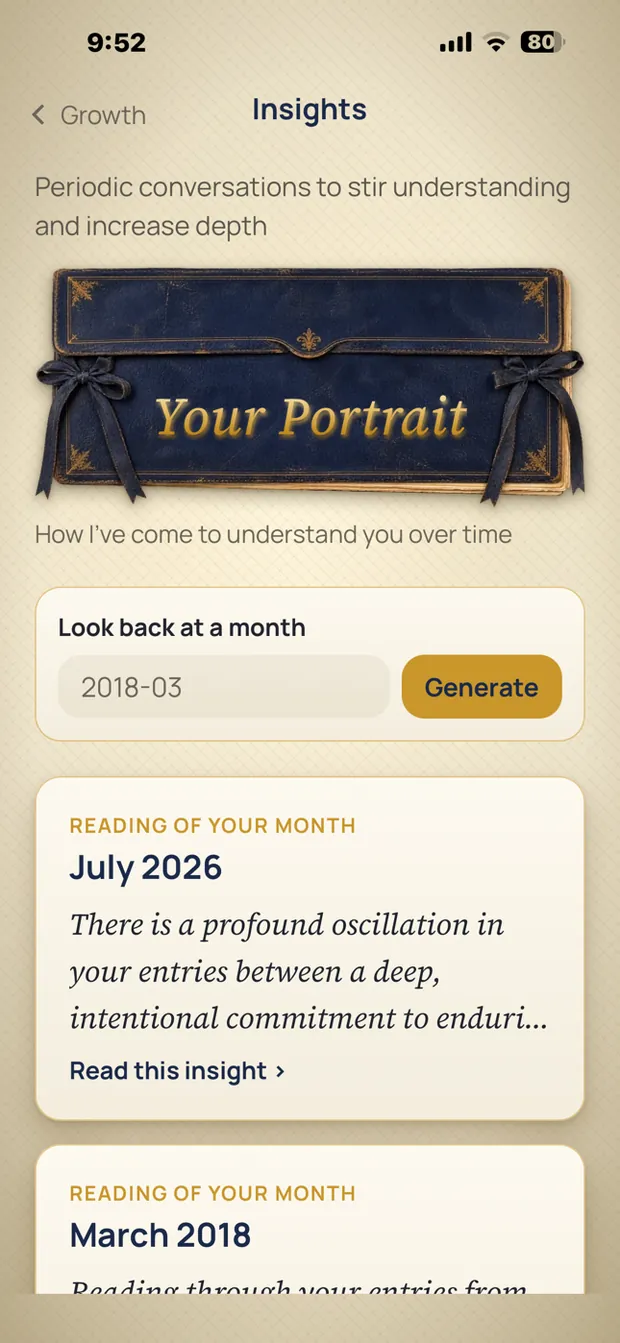
A day at a time, you can’t see it. But a month back, a thread runs through everything — a question underneath your questions, a fear you stopped naming, a change in how you pray that happened so slowly you never noticed it happening.
Once there’s enough to read, Dialect writes it back to you. Not a summary and not a report: a letter, about your own words, tied to the entries behind every line so you can go and see for yourself.
And you can answer it. What you write back becomes part of what the next letter reads — so the understanding deepens season by season instead of starting over each month.
Alongside it, a Portrait: what the app has come to understand about you over time, what it still wonders, and what it does not yet know. It leads with its questions.
A thin stretch stays quiet. There is nothing here to unlock and no reading to force.
Where it stops
There’s a whole category of thing this app intentionally doesn’t do.
- It won’t tell you what God is saying.
- It won’t interpret your dream.
- It won’t predict anything.
There is no sentence in Dialect that begins “God is telling you…” — rather, it puts you in front of Him and gets out of the way, so that what you come to know, you come to know from Him.
It notices, it cites, it asks. When it points at a pattern it shows you the entries it’s pointing at, and you decide the meaning.
It encourages you to listen more, and helps you notice what you hear.
Privacy
What you say in the secret place stays there.
Your voice never leaves your phone. The recording becomes words on the device itself and is then destroyed — the app hears you once and keeps only what you said. There is no audio of you praying anywhere, on your phone or off it.
-
No public anything
No feed. No browsing other people’s prayers. No global switch left on by accident.
-
Sharing is deliberate
One thing, to people you chose, who accepted an invitation. Shared items expire on their own.
-
Your symbols are yours alone
Even on an entry you shared, what your own lexicon did inside it stays with you.
-
Yours to take, and to delete
Export the whole journal whenever you like, as a full backup or a readable archive. Deleting your account removes what’s in it. The privacy policy says exactly what that covers.
Who it’s for
People who pray, and want to deepen their dialogue with God.
Broad historic Christianity. It stays out of the arguments Christians have in-house — with one conviction it won’t hide: God still speaks, and it’s made by someone who believes that.
It doesn’t need you to be good at journaling. It needs you to be willing to pray, with a desire to know God more.
Getting it
Dialect isn’t in the app stores yet.
It’s in closed beta — invitation only, and an invitation comes from someone already using it. If that’s where you heard about it, they have the link.
Questions, or something you want to say about it: support@dialectjournal.com.
App Store and Google Play links will appear here when there’s something real to link to.
Speak freely. He is listening.